The Future of Citizen Services
Government Buildings as Intelligent Operational Hubs
Government buildings are no longer just office spaces. They now operate as intelligent hubs that support daily governance and leadership decisions.
Using applications of IoT in smart buildings, connected sensors monitor occupancy, temperature, air quality, and system performance. Lighting, HVAC, and power systems adjust automatically based on real usage. This improves comfort for occupants and reduces unnecessary energy consumption.
Central dashboards give IT and facility teams continuous visibility into building operations. Maintenance teams can identify issues early and fix them before they disrupt meetings or services. This shift from reactive to predictive maintenance improves reliability and lowers operational costs. It also reduces “surprise failures” during important visits or high-level meetings.
The Gulf region is already moving in this direction. Research from the Wilson Center explains how governments are investing in smart infrastructure to improve resilience and service delivery. The key takeaway for government hubs is simple: start where decisions are made. When the building runs better, the whole institution runs better.
This is how a hub begins to reflect the logic of an IoT-based ecosystem, but in a controlled and secure environment. The goal is not to add more tools; it is to create one connected layer that keeps the building ready, efficient, and easy to manage.
IoT-based Meeting Rooms That Save Time
Meetings are central to government decision-making. Yet many government buildings still suffer from delayed meetings, technical issues, and poorly equipped rooms.
A display that doesn’t connect. A microphone that cuts out. A video call that starts 10 minutes late. Multiply this by dozens of meetings each week, and the time loss becomes massive.
Modern meeting rooms combine displays, video conferencing, audio systems, and room controls into a single platform. With one-touch control, rooms prepare themselves before meetings start. Displays power on. Audio levels adjust. A call launches with the correct camera view. Lights shift for presentations.
This is where smart lighting control systems matter. These systems change brightness based on occupancy and presentation needs. When a meeting starts, the room can switch to “presentation mode.” When it ends, the lights can turn off automatically if nobody is inside. That improves the experience and reduces wasted energy.
These environments also support secure hybrid collaboration. Officials can connect with other ministries, regional offices, and international partners without technical barriers. According to EY public-sector insights, digital collaboration is now essential for effective government operations, not an optional feature. That is especially true for government hubs, where decisions must move quickly.
By embedding IoT solutions into meeting spaces, government hubs reduce setup time and improve meeting outcomes. Leaders can focus on decisions instead of technology. Staff can stop “firefighting” and start managing meetings smoothly.
Energy Efficiency and Cost Control in Government Buildings
Energy use remains a major challenge for government facilities across MENA. Large buildings, long operating hours, and aging systems drive up costs and environmental impact. Many buildings also run at full power even when areas are empty. That means more cost, more waste, and more maintenance.
IoT-enabled building automation systems support continuous monitoring of lighting, HVAC, and power usage. Facilities teams can see where energy is used and where waste happens. They can track usage by floor, zone, and room type. They can also compare performance month to month.
Smart lighting control systems switch lights on and off based on occupancy and daylight. HVAC systems adjust automatically to real-time demand. If a wing is quiet, the building can reduce cooling in that area. If a boardroom is booked, the room can be prepared before people arrive. This is practical. It saves money without reducing comfort.
Research from the Baker Institute highlights that public-sector buildings must lead smart, sustainable upgrades in the region. Government hubs are the most visible place to start. When a ministry reduces its own waste, it sets a standard.
Lower energy use means reduced operational costs, a smaller carbon footprint, and progress toward long-term efficiency goals. It also helps governments meet national targets with real actions inside their own buildings.
Secure, Data-Driven Government Operations
As government buildings become more connected, security and data control become critical. Government hubs handle sensitive meetings, high-profile visitors, and restricted spaces. A smart building must be secure by design. It cannot be “smart first, secure later.”
Access control systems, secure network infrastructure, and centralized monitoring platforms protect sensitive areas such as executive offices and command centers. These systems ensure that only authorized users can access critical spaces and information. They also create audit trails, which help with compliance and accountability.
Operational data from building systems feeds into secure dashboards. Leaders gain real-time insight into space usage, system health, and operational readiness. This supports faster decisions and better coordination between departments. It also helps facilities teams plan upgrades and reduce breakdowns.
According to the U.S. International Trade Administration, governments in the UAE and wider region prioritize secure digital infrastructure to support scalable public services. That includes secure connectivity, reliable systems, and strong digital foundations.
When security, networks, meeting systems, and automation work together, the building becomes predictable. And predictability is what senior officials need most.
What “Smart” Looks Like Inside a Government Hub
A smart government hub is not one device. It is a set of systems that work together. The goal is to reduce friction across the building. Here are the common building areas that benefit most:
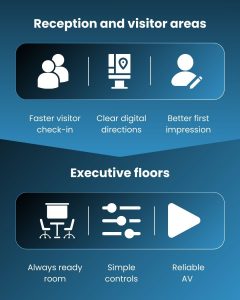
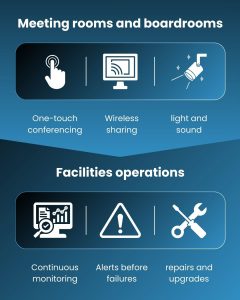
Smart IT Infrastructure for MENA Government Hubs
Government hubs are using smart systems to save leaders time and deliver services faster.
Pressure Points in MENA Government Hubs
In the Middle East and North Africa (MENA), governments face more pressure. They need to provide public services that are faster, clearer, and more efficient. Population growth, urban expansion, and rising citizen expectations are testing the limits of traditional government hubs.
Many designers created ministries, municipal offices, and regulatory headquarters for paper-based workflows and siloed operations. These buildings were built for a different time. Today, senior officials lose valuable time in unproductive meetings and fragmented systems. Teams still juggle too many tools. Basic tasks take longer than they should. At the same time, facility teams manage high energy use and underutilized spaces.
By adopting IoT solutions in buildings, governments can improve decision-making, lower operational costs, and create future-ready public infrastructure.
Government Buildings as Intelligent Operational Hubs
Government buildings are no longer just office spaces. They now operate as intelligent hubs that support daily governance and leadership decisions.
Using applications of IoT in smart buildings, connected sensors monitor occupancy, temperature, air quality, and system performance. Lighting, HVAC, and power systems adjust automatically based on real usage. This improves comfort for occupants and reduces unnecessary energy consumption.
Central dashboards give IT and facility teams continuous visibility into building operations. Maintenance teams can identify issues early and fix them before they disrupt meetings or services. This shift from reactive to predictive maintenance improves reliability and lowers operational costs. It also reduces “surprise failures” during important visits or high-level meetings.
The Gulf region is already moving in this direction. Research from the Wilson Center explains how governments are investing in smart infrastructure to improve resilience and service delivery. The key takeaway for government hubs is simple: start where decisions are made. When the building runs better, the whole institution runs better.
This is how a hub begins to reflect the logic of an IoT-based ecosystem, but in a controlled and secure environment. The goal is not to add more tools; it is to create one connected layer that keeps the building ready, efficient, and easy to manage.
IoT-based Meeting Rooms That Save Time
Meetings are central to government decision-making. Yet many government buildings still suffer from delayed meetings, technical issues, and poorly equipped rooms.
A display that doesn’t connect. A microphone that cuts out. A video call that starts 10 minutes late. Multiply this by dozens of meetings each week, and the time loss becomes massive.
Modern meeting rooms combine displays, video conferencing, audio systems, and room controls into a single platform. With one-touch control, rooms prepare themselves before meetings start. Displays power on. Audio levels adjust. A call launches with the correct camera view. Lights shift for presentations.
This is where smart lighting control systems matter. These systems change brightness based on occupancy and presentation needs. When a meeting starts, the room can switch to “presentation mode.” When it ends, the lights can turn off automatically if nobody is inside. That improves the experience and reduces wasted energy.
These environments also support secure hybrid collaboration. Officials can connect with other ministries, regional offices, and international partners without technical barriers. According to EY public-sector insights, digital collaboration is now essential for effective government operations, not an optional feature. That is especially true for government hubs, where decisions must move quickly.
By embedding IoT solutions into meeting spaces, government hubs reduce setup time and improve meeting outcomes. Leaders can focus on decisions instead of technology. Staff can stop “firefighting” and start managing meetings smoothly.
Energy Efficiency and Cost Control in Government Buildings
Energy use remains a major challenge for government facilities across MENA. Large buildings, long operating hours, and aging systems drive up costs and environmental impact. Many buildings also run at full power even when areas are empty. That means more cost, more waste, and more maintenance.
IoT-enabled building automation systems support continuous monitoring of lighting, HVAC, and power usage. Facilities teams can see where energy is used and where waste happens. They can track usage by floor, zone, and room type. They can also compare performance month to month.
Smart lighting control systems switch lights on and off based on occupancy and daylight. HVAC systems adjust automatically to real-time demand. If a wing is quiet, the building can reduce cooling in that area. If a boardroom is booked, the room can be prepared before people arrive. This is practical. It saves money without reducing comfort.
Research from the Baker Institute highlights that public-sector buildings must lead smart, sustainable upgrades in the region. Government hubs are the most visible place to start. When a ministry reduces its own waste, it sets a standard.
Lower energy use means reduced operational costs, a smaller carbon footprint, and progress toward long-term efficiency goals. It also helps governments meet national targets with real actions inside their own buildings.
Secure, Data-Driven Government Operations
As government buildings become more connected, security and data control become critical. Government hubs handle sensitive meetings, high-profile visitors, and restricted spaces. A smart building must be secure by design. It cannot be “smart first, secure later.”
Access control systems, secure network infrastructure, and centralized monitoring platforms protect sensitive areas such as executive offices and command centers. These systems ensure that only authorized users can access critical spaces and information. They also create audit trails, which help with compliance and accountability.
Operational data from building systems feeds into secure dashboards. Leaders gain real-time insight into space usage, system health, and operational readiness. This supports faster decisions and better coordination between departments. It also helps facilities teams plan upgrades and reduce breakdowns.
According to the U.S. International Trade Administration, governments in the UAE and wider region prioritize secure digital infrastructure to support scalable public services. That includes secure connectivity, reliable systems, and strong digital foundations.
When security, networks, meeting systems, and automation work together, the building becomes predictable. And predictability is what senior officials need most.
What “Smart” Looks Like Inside a Government Hub
A smart government hub is not one device. It is a set of systems that work together. The goal is to reduce friction across the building.
Here are the common building areas that benefit most:
The result is a government hub that works like a complete ecosystem.
Quick Wins: Modernize Without Disrupting Daily Work
Many teams worry that modernization will slow them down. It doesn’t have to. Government spaces can start with quick wins that show impact fast.
Here are simple upgrades that usually deliver results early:
- Standardize meeting rooms so every room works the same way
- Add smart lighting control systems in meeting rooms and corridors
- Introduce room scheduling so staff stop wasting time searching for space
- Deploy dashboards for continuous monitoring of key building systems
- Improve the network so video calls and building systems stay stable
When people see fewer delays, fewer faults, and lower waste, adoption becomes easier. Once the foundation is working, governments can scale the model across spaces.
In a Nutshell.
Smart infrastructure is no longer optional for MENA governments. It is essential for efficient, reliable, and future-ready public services.
By applying IoT solutions within government hubs, authorities can improve meeting efficiency, reduce energy consumption, and strengthen security. Intelligent buildings save executive time and support better decision-making.
When government hubs operate as connected, data-driven environments, public services become faster and more effective. Modernizing these spaces allows governments to lead by example and build resilient institutions for the future.
Smart Government Hub Checklist
- Deploy IoT-enabled building automation systems
- Upgrade meeting rooms with integrated collaboration tools
- Implement smart lighting control systems
- Monitor energy use to reduce operational costs
- Strengthen network infrastructure and security
By modernizing the spaces where decisions happen, MENA governments can deliver smarter governance today and sustainable growth tomorrow.